
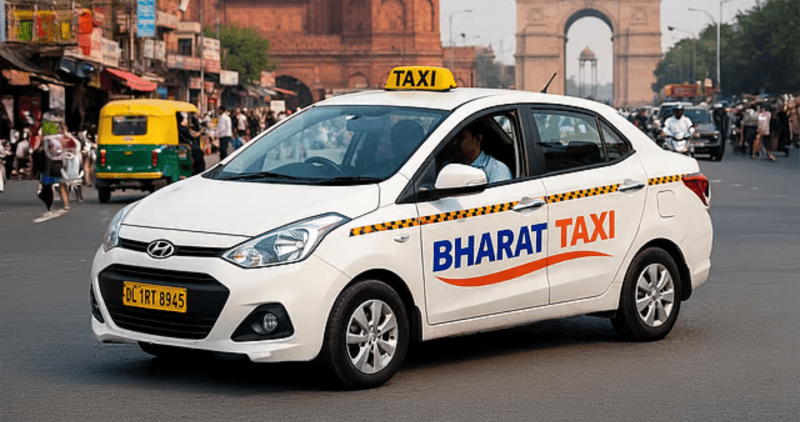
Uber was founded in 2009 and now has around 10 million active drivers and couriers worldwide. Taxi cooperatives exist around the world, but two recent examples in Belgium (Uride) and India (Bharat Taxi) are reaffirming that a platform cooperative alternative remains viable and can be replicated globally.
In Belgium, Uride launched this year, with membership open to both drivers and customers. A member share costs €100, with driver members paying 10% in platform fees (compared to 15% for non-members, or the 25% to 35% paid to other platforms) – and customer members enjoying a 10% discount on journeys.
Meanwhile, in India, a large-scale government-backed driver-owned taxi cooperative was announced during the 2025 International Year of Cooperatives. The Bharat Taxi brand was officially launched this year in New Delhi by India’s Union Cooperation Minister Amit Shah, and is run by Sahakar Taxi Cooperative Limited (STCL) under the Multi-State Cooperative Societies Act, 2002.
Shah said the co-op will share 80% of its profits among its drivers, known as Sarathis, based on kilometres travelled, while the remaining 20% will be used to build co-operative capital. It also offers a zero-commission model, with drivers paying a flat, daily access fee rather than a percentage of each fare. They can also buy shares in the co-op, with a minimum investment of Rs 500, entitling them to voting rights and future dividends.
Shah stressed that the “government is not entering the taxi sector – this is a cooperative initiative”, which will work for the welfare of its drivers; the ultimate aim of Bharat Taxi is to offer drivers a stable, long-term alternative to gig work, promising access to health insurance, accident cover and retirement savings – and to be a platform cooperative model that, with the support of other national governments, could be replicated around the world.
The initiative was supported by India’s National Cooperative Development Corporation (NCDC), which acts as an anchor institution and brought together eight promoter cooperatives and statutory organisations that collectively structured the organisation and finalised governance aspects. NCDC continues to provide operational support, technical partner evaluations and office infrastructure.
“Bharat Taxi operates in a highly competitive and capital-intensive digital aggregation ecosystem, which is characterised by high commission margins and no involvement in decision-making on the part of drivers,” says Rohit Gupta, NCDC Deputy Managing Director
To mitigate some of the budgetary, scaling and trust challenges, the cooperative set up strategic collaborations with railways, state governments, municipal bodies and other cooperative institutions, created low entry barriers to increase participation and carefully controlled its expenditure and phased expansion strategy.
“The early response to Bharat Taxi has been highly positive, reflecting strong acceptance among both drivers and customers,” says Gupta, highlighting that the co-op now has over 400,000 drivers and 2 million customer app downloads.
He adds: “The strong adoption of Bharat Taxi suggests that drivers are actively seeking platforms offering ownership, fair earnings and participation, while customers are increasingly drawn to transparent, affordable and reliable services. This reflects a shift away from traditional models characterised by high commissions, surge pricing and limited worker inclusion.”
Gupta says that the Bharat Taxi project shows how cooperatives can succeed beyond traditional sectors by addressing structural inefficiencies - and including worker voices in decisions.
“Globally, this approach provides an alternative to dominant venture capital-backed platforms by embedding democratic governance and shared prosperity into digital infrastructure. There is significant scope in new and emerging sectors such as household services (cleaning, maintenance), skilled trades (plumbing, electrical work, etc.), beauty and wellness, appliance servicing, AC repair, and maintenance, and local services like tailoring, cobbling, tourism and mobile repair. In many cases, these sectors are fragmented, unorganised, and marked by worker exploitation and discrepancies between price and service quality”
In contrast, the cooperative model gives higher earnings to workers, transparent prices for users and generates employment at scale.
Gupta adds: “The success of Bharat Taxi demonstrates that technology-enabled cooperatives can emerge as a parallel institutional framework in India’s digital economy, extending beyond mobility into a wide range of services.”