As part of her Masters in Anthropology, Lara Douglas visited ICA member NAMAC in Mongolia – and here reports back on how the cooperative model remains a central part of nomadic life.
In Mongolia, knowledge and production have never been separated.
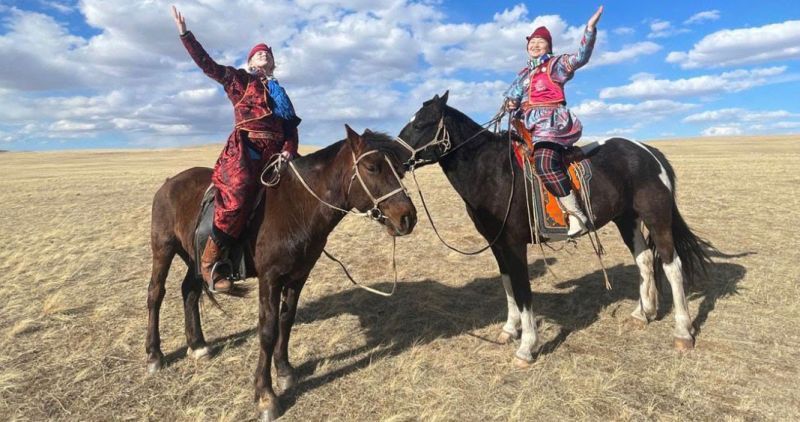
A large part of the population still lives nomadically. They are herders who move their ger (Mongolian yurt) four times a year. Even though these herders have adapted to modern developments like a few hours of electricity each day, smartphones, Wi-Fi and cars, they still herd their flocks from dawn till dusk with motorcycles, horses or cars. They trade within their communities, practice an animistic religion rooted in reciprocity with nature, and live mainly from local products such as dried curd, dried meat, soups, dumplings and traditional milk tea. They have done so for centuries.
This year, I stayed with different nomadic families for approximately two months through, among others, the Mongolian organisation NAMAC, which works with nomadic cooperatives. What fascinated me most was the deep knowledge and cooperation embedded within their way of life. Mongolian nomads practice gendered roles within the herding lifestyle. Men mainly move the flocks from place to place, while women care for their family, prepare food and also tend to pregnant and young animals. Because of increasingly harsh weather conditions caused by climate change, more animals die from the cold winds, especially during spring. As a result, increasing numbers of newborn animals lose their mothers (and the other way around).
Of course, these young animals still need milk, and the nomads use an ancient technique to help newborns bond with a chosen stepmother, a practice passed down through generations. This technique is used whenever a mother animal rejects her child, or when a young animal is motherless and has no bond with its stepmother. In these cases, the newborn will refuse to drink, or the mother will not allow it to.
The Mongolian woman takes the mother animal and the young animal into a more secluded place. She holds the mother still, while it becomes clear that the mother refuses to let the newborn drink. What happens next is remarkable. The woman begins to sing the traditional Mongolian "long song", a beautiful wavering sound that seems to calm both animals. Slowly, the mother relaxes her muscles, lowers her head, and the young animal begins to drink.
This technique is recognised on the UNESCO World Heritage List. The traditional Mongolian "long song" is deeply woven into daily life and care practices within nomadic communities, and is also sung by the nomadic mothers while breastfeeding their own children. For nomadic families, however, it is simply part of daily life, just like milking cows or preparing a meal. Their way of life revolves around a close relationship with the land, the animals and the community around them.
What stands out is how knowledge and daily life remain closely connected. Work is not separated from care, but is part of it. According to the FAO, these kinds of livelihoods have developed over generations in close relation with fragile ecosystems. Mongolian nomads embody this in practice: they are not just producers, but the living carriers of a knowledge system in which every step of the production chain remains in their own hands. In Mongolia, as in many other parts of the world where life is closely tied to seasonal movement and land-based survival, these cooperatives offer a model worth understanding.