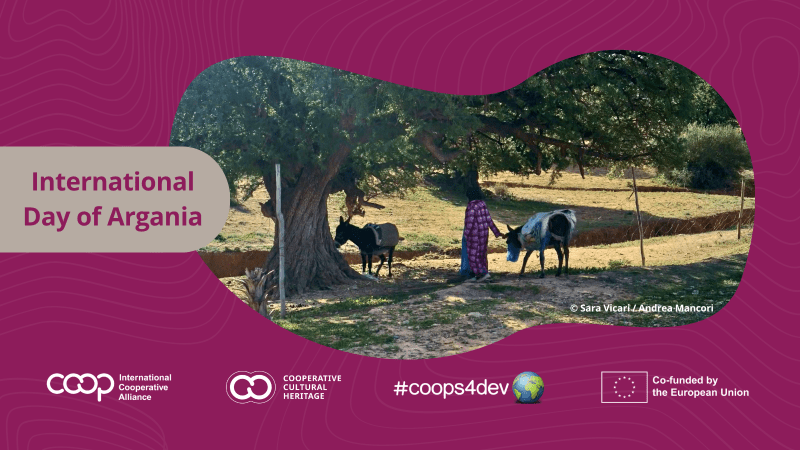
Every year on 10 May, the International Day of Argania recognises the cultural, environmental and socio-economic importance of the argan tree and the communities that sustain it. Celebrated under the auspices of the United Nations, the day highlights how the argan ecosystem contributes to sustainable development, biodiversity conservation and the preservation of ancestral knowledge. The ICA joins this celebration by recognising the vital role played by cooperatives – and especially women-led cooperatives – in safeguarding this unique cultural heritage for future generations.
In Morocco’s argan regions, cooperatives have become much more than economic actors. They are spaces where traditional knowledge is preserved, where women strengthen their economic autonomy and leadership, and where communities collectively protect ecosystems increasingly threatened by climate change and desertification. Through cooperation, the argan tree has become both a symbol of resilience and a living example of how cultural heritage and sustainable development can go hand in hand.
As noted by Tiago Luiz Schmidt, Chairperson of the ICA Working Group on Cooperative Cultural Heritage (CCH): “On the International Day of Argania 2026, we recognize the essential role of cooperation in safeguarding and transmitting our shared cultural heritage. We pay particular tribute to women cooperators whose knowledge, leadership, and commitment sustain communities and keep intangible cultural heritage alive across generations. Through collective action, solidarity, and shared memory, we strengthen cultural diversity and reaffirm heritage as a vital resource for social cohesion, resilience, and sustainable development”.
This message reflects the spirit of the CCH programme of the ICA, which works to safeguard tangible and intangible elements of cooperative cultural heritage around the world. In the case of argan production, the cooperative model has demonstrated how communities can simultaneously protect biodiversity, sustain livelihoods and preserve cultural identity.
According to the Department of the Promotion of the Cooperative Sector of the Office du Développement de la Coopération (ODCO) of Morocco, women-led argan cooperatives have transformed what was once a domestic and largely informal activity into a modern cooperative ecosystem rooted in solidarity and sustainability. These cooperatives help protect the UNESCO-recognised Arganeraie Biosphere Reserve, which covers more than 2.5 million hectares in the Souss-Massa region and acts as a natural barrier against desertification.
The ODCO also highlights the strong social impact of the cooperative model. By organising into cooperatives, women producers gain financial autonomy, participate in decision-making and access literacy and management training opportunities. Cooperatives have therefore become important community hubs where economic empowerment is directly linked to social inclusion and local development.
At the same time, these cooperatives remain guardians of ancestral Amazigh knowledge associated with the argan tree. Traditional techniques – such as the manual cracking of argan nuts using stone tools – continue to be transmitted between generations, ensuring that the cultural practices surrounding argan oil production remain alive. As the ODCO notes: “The argan cooperative is not just a place of work; it is a space for social innovation”.
This interconnection between people, culture and biodiversity is also recognised internationally through the work of the Food and Agriculture Organization of the United Nations (FAO). Through its Globally Important Agricultural Heritage Systems (GIAHS) initiative, FAO recognises the Moroccan argan-based production system as a globally significant agricultural heritage system that combines biodiversity conservation, traditional knowledge and sustainable livelihoods.
The FAO highlights how the argan ecosystem supports local communities while preserving fragile environments and maintaining centuries-old practices adapted to arid conditions. The system demonstrates how traditional agricultural knowledge can contribute to climate resilience, food security and sustainable resource management in the face of growing environmental challenges.
The cooperative movement has long recognised the importance of argan cooperatives as a model of sustainable and inclusive development. In 2022, the ICA marked the International Day of Argania by emphasising the role of cooperatives and the argan tree as intangible assets for sustainable development. More recently, in 2025, the CCH programme included the argan ecosystem and the women’s cooperatives that sustain it in its List of Tangible Cooperative Cultural Heritage, recognising their global cultural significance.
The experience of cooperatives such as the women’s cooperative Toudarte, featured in the ICA-EU #coops4dev🌍 “Around the World” video series, further illustrates how cooperation creates opportunities for women while preserving local heritage and traditional know-how. Through collective organisation, women producers have strengthened their position within their communities and connected local traditions to global markets without losing their cultural identity.
Today, as the world celebrates the International Day of Argania, the ICA reaffirms that cooperatives are essential actors in preserving cultural heritage, empowering communities and advancing sustainable development. The argan tree stands not only as a natural resource, but also as a symbol of collective memory, solidarity and resilience – values deeply embedded in the cooperative identity.
If you are interested in the Cooperative Cultural Heritage programme, or if – like the argania cooperatives – you know of a cooperative, site, practice or tradition that deserves international recognition for its cultural significance, the ICA encourages you to explore the CCH initiative and participate in the current call for nominations to the Cooperative Cultural Heritage List.
This article has been produced under the ICA-EU Partnership (2024–2028), also known as #coops4dev🌍, a five-year international cooperative development programme co-funded by the European Union, aimed at strengthening the ICA network and positioning cooperatives as key actors in international development.