
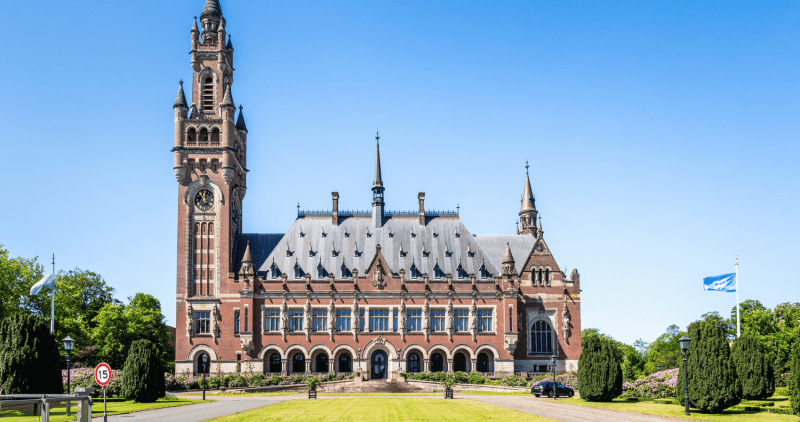
The International Court of Justice Advises on the Right to Strike
In 2023, the International Court of Justice invited the ICA to give its opinion on an International Labor Organisation (ILO) question concerning the right to strike, through its special consultative status with the ILO.
The question revolved around whether workers’ rights to strike were protected under the Freedom of Association and Protection of the Right to Organise Convention (ILO No. 87); the ICA’s written submission advocated for upholding decent work and rights of workers and was delivered in person to the Registry of the Court in June 2024 by Prof Hagen Henry, Chairperson of the ICA Cooperative Law Committee (CLC), and Santosh Kumar, ICA Director of Legislation.
“The ICA’s participation represented the defence of cooperative interests, and reflected the movement’s longstanding commitment to advancing social justice, democratic participation, and fundamental rights at work,“ said Kumar.
In its submissions, the ICA argued in favour of recognising the right to strike as an integral component of Convention No. 87 and emphasised the broader importance of freedom of association within democratic societies and economic institutions. In May 2026, the Advisory Opinion delivered by the ICJ held that the right to strike is indeed protected under Convention No. 87.
“For the global cooperative movement, the significance of the Opinion extends well beyond the recognition of a particular labour right,” adds Kumar. “The Court’s reasoning illuminates the broader legal framework through which freedom of association, social dialogue, and democratic participation are protected under international law. Equally important, the Opinion confirms the centrality of the ILO Constitution, the interpretative authority of the ILO supervisory system, and the relevance of customary international law in the development of international labour standards.”
These, he says, are “matters of profound importance” for cooperatives, whose identity and institutional legitimacy are deeply intertwined with the principles of democratic governance, participation, and social justice reflected in international labour law and embodied in the ICA Statement on the Cooperative Identity.
Kumar believes that as the international community reflects upon the implications of the Court’s Opinion, “cooperatives have good reason to view it as more than a victory for workers’ rights alone. It is also an affirmation of the broader legal order that sustains democratic economic participation, supports cooperative enterprise, and advances the pursuit of a more inclusive, equitable, and socially just global economy”.
The workers of the world may indeed unite, but, as the Court has now affirmed, they do so in greater solidarity and in dignity.
Read Santosh Kumar’s full analysis in the attached document (in English)