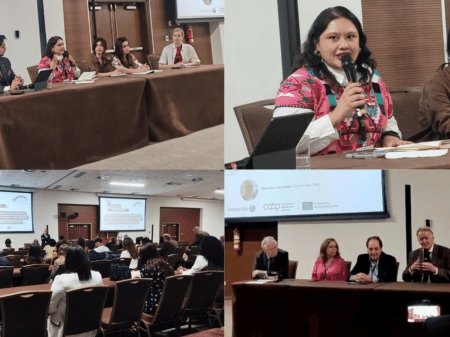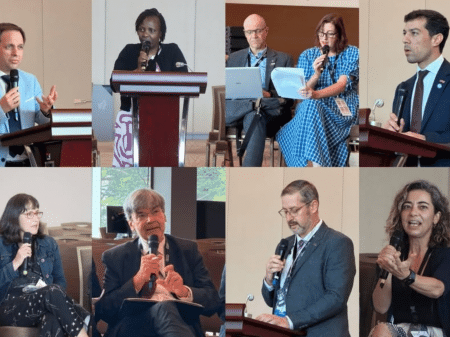

Throughout the Conference week, ICA structural organisations celebrated regional, sectoral and thematic side events, bringing together delegates from around the world in Panama City.
The International Cooperative Banking Association (ICBA) held its board meeting and general assembly, and organised bilateral meetings – as well as a seminar on the crucial issues facing cooperative financial institutions. Opened by ICA Director General, Jeoren Douglas, and Cooperatives of the Americas regional director, Danilo Salerno, the seminar was moderated by Dr. Carlos Hellar (Banco Credicoop), and provided a valuable opportunity for over 40 members and delegates to exchange insights, engage in meaningful discussions, and explore emerging opportunities and challenges.
Cooperative expert Robby Tulus looked at issues of governance and democratic control, while DotCooperation CEO, Violetta Nafpaktiti, spoke about digital transformation and technology - and their role in a stronger cooperative movement. ICMA president Bhima Subrahmanyam explored the challenges behind defining and developing dedicated cooperative financial infrastructure, and Veronica Molaris, Manager of Digital Transformation and Strategic Planning at Cooperativa Riobamba, shared her organisation’s experience of driving the growth of Ecuador’s productive sector.
____
The International Cooperative Agricultural Organisation (ICAO), the ICA's sectoral organisation for agriculture, held its General Meeting, bringing together around 40 delegates from 14 member organisations in 12 countries. Founded in 1951, ICAO brings together 45 organisations in 35 countries.
Chaired by ICAO President Kang Ho-dong, Chairman of Korea's National Agricultural Cooperative Federation (NACF), the one-hour session approved the 2025 activity report and accounts and the 2026 work plan and budget; returned Mr Kang unopposed as President for a further four-year term; and elected four regional Vice-Presidents (Ivan Asiimwe (Uganda Cooperative Alliance), Márcio Lopes de Freitas (OCB, Brazil), Akihiro Fukuzono (JA-Zenchu, Japan) and Mieczysław Grodzki (NCC, Poland)).
Mr Kang, who continues to represent ICAO on the ICA Board, pledged to carry forward the ICAO Seoul Declaration, adopted unanimously in 2025, and to spread NACF's Nongsim Cheonsim movement ("the heart of the farmer is the will of heaven") among member organisations, towards "agriculture that brings hope to all and rural communities where everyone is happy".
"Solidarity among cooperatives is more urgent than ever as global agriculture confronts climate change and food insecurity," he said. "Guided by the spirit of the Seoul Declaration, we will build a sustainable future for agriculture and rural communities in which farmers are respected."
___
The Gender Equality Committee held an event open to the entire ICA membership under the title “What do we need to move forward together?” The workshop brought together, among others, GEC President Xiomara Núñez, Vice-Presidents Ana Olveira and María Eugenia Pérez, the Presidents of the Gender Committees of the Asia-Pacific and Americas regions, Chitose Arai and Gisela Wild, respectively, numerous members of the GEC Executive Committee and GEC membership, as well as around 30 participants representing a wide range of organisations.
During this interactive workshop, participants worked in groups to discuss questions such as: What does ICA need to learn to integrate a gender perspective? What barriers do we identify within ICA structures? What should the GEC promote? What shared wisdom do we already have in our network?
The objective was to gather participants’ ideas, experiences, and perspectives on the needs and challenges the ICA faces in integrating a gender perspective within the organisation and the cooperative movement. The contributions will help identify priorities and shape the GEC’s future work.
____
A meeting convened by the International Cooperative Entrepreneurship Think Tank (ICETT) discussed how the committee can strengthen the evidence and data needed to support advocacy for cooperatives and position the movement more effectively in key policy processes. The meeting also considered ICETT’s role as a more strategic, evidence-driven and action-oriented platform, with a focus on developing practical tools and research to demonstrate the contribution and impact of cooperatives.
A key focus was the upcoming 2027 SDG Summit and the post-2030 agenda, including what evidence and publications are needed to ensure that cooperative contributions are clearly reflected in global development discussions. The meeting also explored different approaches and frameworks for collecting and measuring cooperative impact, and underscored the importance of linking data, research and storytelling so evidence can be translated into effective advocacy. ICETT will therefore explore what data should be collected, how it can be presented, and which policy entry points can be used to strengthen the cooperative voice in the lead-up to the 2027 SDG Summit and the wider post-2030 agenda. This aligns with the proposed 2027 workplan, which identifies evidence and research on cooperative contributions to sustainable development, as well as opportunities to support policy discussions and advocacy, as key areas of work.
___
During the week, a session on Global Cooperative Dialogue: Regional and Sectoral Challenges, Shared Opportunities was organised by COCETA (the Spanish Confederation of Worker Cooperative), KONFEKOOP (the Confederation of Cooperatives of Euskadi, COCETA’s regional member organisation in the Basque Country), and CICOPA (International organisation of industrial and service cooperatives), based on the shared conviction that the future of the cooperative movement is built through dialogue, collaboration, and intercooperation.
The event brought together representatives of cooperative organisations from different parts of the world to reflect on the common challenges facing the cooperative movement and the opportunities that emerge when organisations work together. Participants included Luis Miguel Jurado, President of COCETA; Rosa Lavín, President of KONFEKOOP; Giuseppe Guerini, President of Cooperatives Europe; Osamu Nakano and Christian Horton, Vice-Presidents of CICOPA for CICOPA Asia-Pacific and CICOPA Americas; and other cooperators from Spain, France, Belgium, Japan, and Italy.
The discussion highlighted the importance of strengthening international cooperation among cooperatives, sharing experiences across regions and sectors, and promoting collaborative solutions to address economic, social, and environmental challenges.
___
The ICA programme on Cooperative Cultural Heritage (CCH), was launched in Brasilia during the United Nations International Year of Cooperatives in 2025, with ICA members and cooperative organisations worldwide invited to nominate further tangible and intangible elements of cooperative cultural heritage in 2026. In a ceremony in Panama, Thiago Schmidt, Chairperson of the ICA CCH Working Group, announced the 2026 inscriptions, comprising 63 new sites and elements from 39 countries. Among the intangible elements recognised was the cultural heritage associated with Panama’s Pinta’o hat, whose knowledge, craftsmanship and traditions are safeguarded and transmitted by local communities, including through cooperative organisation.
Attendees also heard about the move to developing cooperative heritage trails, which connect places, institutions, people and practices that may be geographically separated but form part of a shared history or tradition of cooperation. The ceremony in Panama similarly underscored a central idea of the programme: cooperative heritage belongs not simply to buildings, archives or institutions, but to people and communities who keep cooperation alive as a cultural practice. A special webinar will be organised in October to mark the International Day of the Intangible Cultural Heritage, and plans were announced for an international seminar in Kerala, India, in October 2027, conceived as an ICA contribution to marking the beginning of the United Nations Decade of Culture for Sustainable Development.
___
Co-operative Housing International (CHI) held a Board meeting during the week, alongside a general assembly which formally noted the transfer from CHI (which had been an unincorporated committee of the ICA since its establishment), to CHI Limited, an incorporated organisation. This gives it the same legal status and footing as ICA sector bodies such as ICMIF and CICOPA and regional organisations such as Cooperatives Europe. Blase Lambert, CHI Treasurer, said: “I see this as potentially the direction of travel for all of the sectors and regions of the ICA over time as it improves governance and transparency, but it also allows them to move to a model where they're able to look at their own streams of financial activity and their own projects in a way that the unincorporated committee structure doesn't support.”
A later CHI plenary session welcomed the Minister for Housing from Panama, alongside two senior civil servants from the Housing Ministry, with delegates also hearing from sector experiences from the UK, Chile and Malaysia, as well as speakers from the floor sharing stories from Argentina and Uruguay. There is currently no cooperative housing in Panama, but CHI hopes that positive engagements with ministers will provide a startup opportunity for the sector.
“Here the tendency is for the government to provide loan capacity to cooperatives that then build homes for people and then sell those homes to individuals,” explains Lambert. “The model in Latin America is much more about enabling home ownership.”
___
CICOPA (The International Organisation of Industrial and Service Cooperatives) and CICOPA Americas hosted an event titled "Building the Care Economy Together: Cooperative Solutions for Decent Work and Inclusion. A Focus on the Americas", bringing together representatives from the Americas and other regions. The session explored the challenges, opportunities, and promising practices of care cooperatives, highlighting their contribution to quality care, decent work, gender equality, and social inclusion.
Diana Dovgan, Secretary General of CICOPA, opened the session with a global overview of the growing role of cooperatives in addressing care needs while creating decent jobs. Delegates heard about experiences in Argentina, the USA and Canada, as well as interventions from Japan, Morocco, and regional representatives from ICA Africa and ICA Asia Pacific. These discussions confirmed that, across very different national contexts, care cooperatives are helping to tackle common challenges: improving access to care, creating decent jobs, supporting women's economic empowerment, and building more inclusive communities.
___
The International Cooperative Alliance Development Platform (ICADP) side event brought together 25 representatives from Cooperative Development Organisations (CDOs) across all regions of the ICA to discuss the changing context, explore future collaborations, and strengthen connections between regional platforms, national agencies, and other development actors.
Delegates heard from the four regional and global platforms, the CEDP (Europe), CADP (Americas), AFCDP (Africa), APCDP (Asia-Pacific), and ICADP (Global), with each platform coordinator presenting key highlights from the past, current activities, and future ambitions. The following discussions focused on how CDOs and development platforms can reinforce one another in accessing funding and finance, as well as on identifying concrete opportunities for joint initiatives. The MiCDP database (https://micdp.coops4dev.coop/) will continue to serve as a knowledge hub, while an exchange on donor strategies will also be initiated to support greater coordination and learning among the organisations.
The meeting also included the elections of the ICADP Executive Committee members and Presidency for the 2026-2030 mandate. Noel D. Raboy (CLIMBS), François Dionne (SOCODEVI), Sarah Alldred (FICD), and Francesca Ottolenghi (Legacoop) were confirmed as members, with Ottolenghi also beginning a second mandate as Committee President.
___
Conference attendees had the opportunity to explore the idea of Cooperative AI: Shaping the Future Together in a session hosted by the ICA, Legacoop and the Pico Foundation (LegaCoop's digital innovation hub), which launched the Cooperative AI programme, with the aim of becoming a leading player, influencing the development and governance of AI according to the cooperative identity.
A survey conducted of ICA members earlier this year showed patchy AI adoption (31 of 45 respondents are already using AI tools, but only 3 have a strategic plan), but a strong interest in ethics, communities of practice and pilot projects. The speakers argued cooperative identity should be a design framework for AI, not an afterthought, and outlined a three-pillar program (common understanding, common ground, common benefits) modelled loosely on the UN's AI advisory pillars.
Live polls asked attendees to describe cooperative AI in one word (leading answers: idealistic, democratic, data protection, hopeful) and to pick the cooperative principle that should guide AI (democratic member control led, ahead of concern for community), followed by discussion of why control and data ownership dominate people's anxieties. The session closed with the organisers stressing this is a starting point for an ongoing global community of practice rather than a finished framework, and inviting participants to find out more about the Cooperative AI bootcamp being hosted in Italy in October.