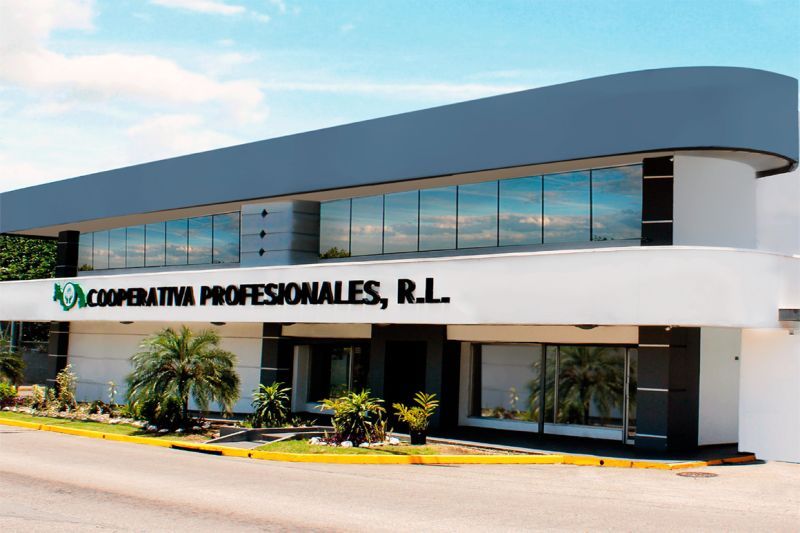
The 2026 ICA Global Conference and Assembly is being jointly hosted by the ICA’s two members in Panama: Instituto Panameño Autónomo Cooperativo (IPACOOP) and Cooperativa de Servicios Múltiples Profesionales (Cooperativa Profesionales). Read our interview with IPACOOP here, and find out more about Cooperativa Profesionales below!
Tell us about Cooperativa Profesionales. What does it do, and who are its members?
Our history is, to a great extent, the story of how a specific need can grow into an institution with a much broader vision.
Cooperativa Profesionales, R.L. was founded in 1970 with a very specific purpose: to respond to the economic and social needs of health professionals. It began operations with 112 members, mainly doctors, dentists and related professionals linked to the Social Security Fund (Caja de Seguro Social).
Over the years, that vision expanded. Today, we are a multi-service cooperative that seeks to support our members and their families across different dimensions of their lives, through financial products and services, a managed health plan, savings, credit, social benefits and other initiatives.
Our membership eligibility has also evolved. Starting in 1995, members' children were admitted, and other health-sector professionals were gradually incorporated, such as nutritionists, veterinarians, psychologists, physiotherapists, speech therapists, optometrists and others.
That's why, rather than speaking only of a financial institution, we prefer to describe ourselves as an organisation created by professionals and for professionals, their families and their wellbeing.
Today the challenge is no longer just to grow. It is to make sure that an institution with more than five decades of history remains relevant to new generations and can respond to an economic, technological and social environment that is completely different from that of 1970.
As a multi-service cooperative, how do members participate in decisions about the services offered? Could you share a recent example of how this works in practice?
This is precisely one of the major differences between the cooperative model and a traditional company: our members are not only users of the services; they are also owners of the organisation.
Participation is channelled through our cooperative governance mechanisms: chapter meetings, delegates and the General Assembly, along with the Cooperative's various bodies and committees. Delegates are members elected by vote and are responsible for representing other members before the Assembly.
In addition, our chapter-based structure helps maintain that connection with members across different regions of the country. The chapters function as spaces for participation and communication between members and the Cooperative's management.
A recent example of this philosophy is the strengthening of participation among younger generations. In 2025, the Youth Subcommittee was created as a response to the need to promote participation, training and generational renewal within the Cooperative.
This shows that participation should not be limited to voting once a year. We want our members to be able to propose, debate, participate and help build the Cooperative they need.
You are one of only two Panamanian organisations that are members of the ICA. What does it mean, in practice, to be part of this international organisation?
Being a member of the ICA means much more to us than belonging to an international organisation.
It means being part of a global movement that brings together cooperatives from different sectors and countries and that shares principles and values based on democracy, solidarity, participation and the pursuit of collective wellbeing.
In Panama's case, Cooperativa Profesionales is a full member of the ICA, while IPACOOP holds associate membership.
In practice, this membership allows us to learn from other experiences, share our own good practices, take part in international discussion spaces and help position the needs and contributions of Panamanian cooperativism on a global agenda.
And there is something particularly important: it allows us to understand that many of the challenges we face – digital transformation, financial inclusion, sustainability, youth participation, health, care and generational renewal – are not unique to Panama. They are challenges being experienced by cooperatives all over the world, ones we can address through cooperation and shared knowledge.
What does it mean for Cooperativa Profesionales and its members to welcome the global cooperative community to their country for the joint ICA and Cooperatives of the Americas conference?
This is, without doubt, a historic moment for Panamanian cooperativism. For Cooperativa Profesionales, this means taking on a very special responsibility: being both hosts and, at the same time, ambassadors for Panamanian cooperativism.
The Global Conference will be held under the theme "Building bridges: cooperative contributions to a peaceful world." Panama is a country that has historically built bridges between continents, cultures and economies. The fact that the global cooperative movement is gathering here carries enormous symbolic value.
But we want this conference to leave behind more than photographs and encounters. We want it to generate alliances, knowledge, opportunities for cooperation and projects that continue after the event ends.
For our members, it is also an extraordinary opportunity to understand that they belong to a movement much bigger than their own organisation: a global cooperative community seeking collective answers to the great challenges of our time.
How does Cooperativa Profesionales work with counterpart organisations, both in neighbouring countries and within the international cooperative movement?
Cooperation among cooperatives is one of our core principles, and we believe it must translate into concrete action.
We work through our participation in national, regional and international spaces, sharing experiences, knowledge and good practices, but also building alliances around issues that matter to our organisations and our members.
In addition, our international participation allows experiences developed in Panama to become known in other countries, while also letting us adapt successful experiences from other cooperatives to our own reality.
For us, cooperating doesn't just mean helping each other as cooperatives; it means building together solutions that would be much harder to achieve individually.
A very significant example took place in 2025, when Cooperativa Profesionales took an active part, together with Cooperatives of the Americas and IPACOOP, in the regional closing event for the International Year of Cooperatives in Panama. More than 400 cooperators took part in that gathering, which addressed topics such as the care economy and society, sustainability, innovation, inclusion and development.
The International Year of Cooperatives 2025 was an opportunity to look outward, but also to look inward and ask ourselves what it really means to be a cooperative in the 21st century. But we believe the International Year did not end in December 2025. The real challenge is turning that momentum into a permanent agenda toward 2030.
How is the cooperative adapting to the challenges and opportunities of the next decade, and what do you consider its broadest contribution to Panamanian society?
The next decade requires us to think differently.
Ahead of us are challenges such as digital transformation, changes in our members' consumption and interaction habits, the incorporation of new generations, sustainability, competition in the financial sector, and the need to offer increasingly agile and personalised services.
That's why we are working on several fronts: digital transformation, innovation, strengthening cooperative governance, financial and cooperative education, generational renewal, and a member experience that is ever closer and more relevant.
But our transformation cannot be only technological. We want it to be cultural and organisational as well.
The question we must ask ourselves is not only "what services will we offer in ten years?" but "what will our members need in ten years, and what can we do today to be ready?"
And our contribution to Panama goes beyond the services we provide. As a cooperative, we help generate economic and social wellbeing, strengthen the culture of savings, facilitate access to financing, promote education and develop initiatives related to health and wellbeing.
Ultimately, we want to show that cooperativism is not a model of the past. It is a model with a lot of future when we are able to combine our historical values with innovation, technology and a genuine vision of people's needs.