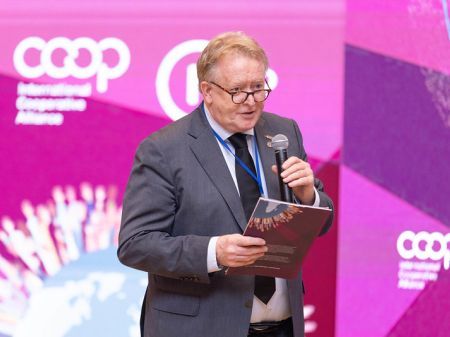
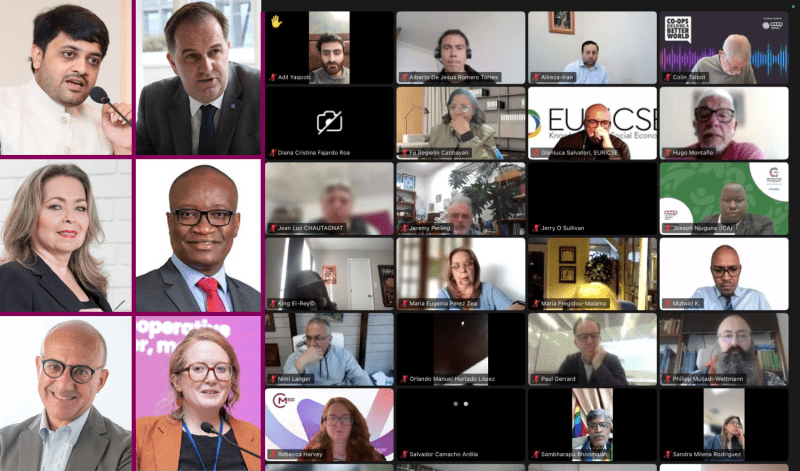
On 27 January, the International Cooperative Alliance (ICA), the European Research Institute on Cooperative and Social Enterprises (EURICSE) and the International Cooperative Entrepreneurship Think Tank (ICETT) hosted a webinar on the World Cooperative Monitor 2025 – Special Edition, marking the conclusion of the UN International Year of Cooperatives (IYC2025).
The World Cooperative Monitor (WCM) is the leading global reference on the economic scale, scope and performance of the world’s largest cooperatives and mutuals. Produced annually by the ICA and EURICSE, with the support of the ICETT, it provides robust and comparable data on the global cooperative movement through its Top 300 rankings and sectoral analysis. The 2025 edition also includes interviews with cooperative leaders from the CM50, the Cooperatives and Mutuals Leadership Circle.
The webinar, moderated by Ilana Gotz (senior project manager, EURICSE), presented key findings and global trends from the WCM 2025, with examples of cooperative impact across sectors and regions and a discussion on how the WCM could look in the next decade.
Opening the event, Jeroen Douglas, Director General of the ICA, said the top 300 cooperatives and mutuals generate a combined annual turnover of USD 2.7 trillion, placing them on par with the world’s largest national economies. “This document shows that there is significant space for cooperatives and mutuals to grow in the market space,” he said. “We all feel in these disturbing times that we have reached the end of history and are entering a new big story. Cooperatives and mutuals can play a pivotal role in this.”
He added that the launch of the WCM during the World Social Summit in Doha coincided with the publication of the CM50’s manifesto (A Contract for a New Global Economy) and the ICA’s 2026-2030 strategy (Practice, Promote, Protect).
The CM50 was convened by the ICA to expand the cooperative and mutual sectors’ market share as part of the UN 2030 Agenda on Sustainable Development and beyond. Several members were interviewed by Co-op News, with extracts from the interviews published in the WCM.
__
Presenting the findings of the WCM, Gianluca Salvatori, Secretary General of EURICSE, told how, despite global turbulence, the 300 largest cooperatives in the world showed consistent growth from 2017 to 2023, proving their resilience and stability. Another important takeaway, he said, is that while the movement is often recognised for its deep roots in local communities, “cooperation is not confined to the local level, and is not an alternative to scale”.
Salvatori believes data collection for future editions of the WCM should be broader. “For 13 years, we rightly focused on proving scale. But today we should ask a different question: What difference do cooperatives make? Beyond size, it's time to measure other dimensions, such as the quality of work, social capital, environmental impact and democratic participation. We must measure not only how large companies are, but how transformative.”
__
Rebecca Harvey, Executive Editor, Co-op News, who led the series of interviews with CM50 leaders, said that while the numbers in the WCM are impressive, they only tell half the story. “In the context of the IYC 2025 and ambitions to grow the co-op movement, the facts and figures need more context to explain how the cooperative movement can make a genuine difference to members, employees, communities and the planet.”
The conversations capture a picture of cooperative difference, she added, and a diverse cooperative ecosystem “that demonstrates how businesses can be run in a way that is democratic, sustainable, and people-centred - and also be incredibly successful.” But there is still a need for support, she warned. “The message from the leaders we interviewed was clear: recognition, enabling regulation, and accelerated scaling are essential to help the global movement thrive.”
__
Attendees also heard impact stories from cooperative leaders within the agricultural, consumer, finance and insurance sectors.
Manish Sanghani, chair of the Amreli District Cooperative Union, and Tarun Bhargava, Senior General Manager of IFFCO (India), shared the impact of the cooperative model on India’s many agricultural cooperatives. Sanghani gave a short history of IFFCO and how its farm-centric approach,, “of the farmers, by the farmers, and for the farmers,” served around 50 million farmers through 36,000 Member Societies.
The turbulent global situation has affected IFFCO, like other businesses, said Bhargava. “But despite global challenges … we ensure farmers receive fertilisers even under difficult conditions.” Beyond agriculture, IFFCO supports farmers with medical assistance, educational scholarships, and women’s empowerment initiatives.
__
Paul Gerrard, Campaigns, Public Affairs and Policy Director at the UK’s Co-operative Group, described how the organisation uses its scale and reach to create impact for and on behalf of members. “We’re not just a big business, we’re a big business with values,” he said, which campaigns on public policy issues that are raised and voted on by members, such as modern slavery, violence against shopworkers and putting co-ops at the heart of building peace in post-conflict regions.
“As owners of the Co-op, our members have told us what to campaign on, and we have executed their wishes,” he said. “That is a genuine example of the value of being an owner of a cooperative and the social value that cooperatives can create.
__
The Cooperative Bank of Kenya is the largest bank in the country. “We focus on the cooperative model in everything that we do,” said Vincent Marangu, Director of its Co-operatives Banking Division. It has a dedicated business division that takes care of cooperative business, which in particular supports cooperatives working in agriculture, transport, housing and investment, and also runs a consultancy service offering cooperative advice and training.
“The Cooperative Bank was formed for moments of crisis,” he said, highlighting how during Covid, it received exceptional approval to pay dividends to its cooperative shareholders.” Beyond banking, the organisation has supported the government in reforming the coffee sector in Kenya by introducing the direct settlement system, and extended support to other agricultural cooperative sectors, education and consultancy.
__
Joining the meeting from Colombia, María Eugenia Pérez Zea, President, Coomeva Cooperative Business Group, described how the organisation was founded “by a group of medical professionals who initially decided to get together after losing one of their co-workers, whose family was left without any income”.
This solidarity approach is still a “fundamental cornerstone” in how the cooperative “protects members and their families and [helps them] build a safer future,” she said. Today, the Group operates in finance, health, protection services, and social initiatives – and has developed a number of solidarity funds that “demonstrate we are a different model, which is innovative in our scale, but will always serve our communities”.
__
Closing the event and reflecting on the way forward for the World Cooperative Monitor, ICETT chair Thomas Blondeel (who is also International Advocacy officer at SmartCoop in Belgium) said the next step is to “redetermine the objectives of the Monitor and create a renewed format that meets the goals of documenting and promoting the impact that our cooperatives have on a global scale.”
Evaluation and planning sessions are planned for the coming months, added Blondeel. “If you would like to participate, I warmly appeal to you to reach out. Let’s work together so the monitor can become a global observatory of cooperatives and an even better strategic communications tool.”
The slides shown during the event can be downloaded below, and the full event can be watched back here. For more information on the WCM, visit: monitor.coop/ or contact ICETT@ica.coop or njuguna@ica.coop.